
State of Health Is Not Always the Same: AVILOO Brings Transparency to EV Battery Assessment
When buying a used electric vehicle (EV), the battery is the most critical component—and often the biggest unknown. Its health determines range, performance, and resale value. The State of Health (SoH) metric was introduced to provide guidance, but what does it really mean? And why can results vary so much? AVILOO, the global leader in independent battery diagnostics, explains the facts and offers solutions for clarity and trust in the EV market.
What Is State of Health (SoH)?
SoH indicates the condition of an EV battery compared to its original state. However, it’s not a direct measurement—it’s calculated. And here’s the challenge:
- Different reference values and calculation methods exist, leading to inconsistent results.
- Buyers and sellers often rely on SoH without understanding what it truly represents.
“SoH is not always SoH,” says Patrick Schabus, Chief Product Officer at AVILOO. “Depending on whether capacity or energy is used as a reference and whether the calculation is done at pack or cell level, the results can differ significantly.”
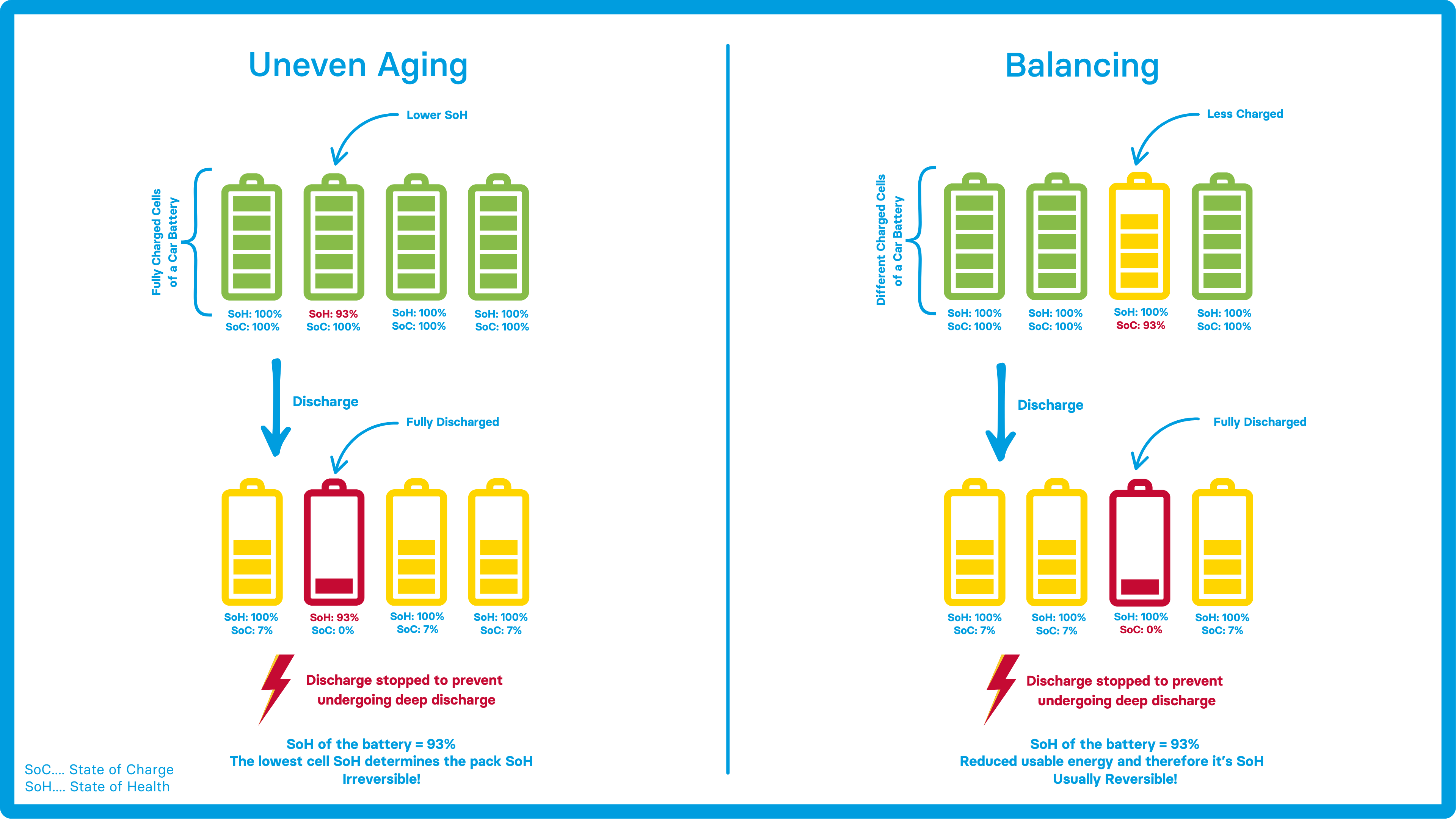
Capacity vs. Energy: Two Approaches, Two Realities
- Capacitive SoH: Based on remaining capacity in ampere-hours.
- Pros: Simple concept, theoretically independent of temperature and driving style.
- Cons: Ignores internal resistance, often overestimating range—especially in older vehicles.
- Energetic SoH: Measures usable energy in kilowatt-hours.
- Pros: Directly linked to range.
- Example: 90% energetic SoH means 90% of the original range is still available.
- Cons: Complex calculation influenced by temperature and load profile. AVILOO standardizes this using the WLTP cycle at 23 °C.
Pack Level vs. Cell Level: Accuracy Matters
The calculation method impacts reliability:
- Pack-Level Analysis: Quick but imprecise—only rough estimates.
- Cell-Level Analysis: Highly accurate, as it evaluates each individual cell and its balancing status.
Two common approaches:
- Average Cell Method: Widely used but inaccurate, as it overlooks weak cells.
- Weakest Cell Method: The most precise—like the weakest link in a chain determining overall strength.
The AVILOO Solution: State of Certified Energy (SoCE)
AVILOO introduces SoCE, an energetic SoH calculated at cell level, based on the internationally recognized GTR22 standard.
- Measures usable energy under defined conditions.
- Uses the weakest cell for calculation.
- Provides transparent, traceable, and independent results.
“Our goal is to show the actual remaining range compared to the original state—accurately and reliably,” says Schabus.
AVILOO Tests: Precision for Every Scenario
AVILOO PREMIUM Test
- The most comprehensive EV battery analysis worldwide.
- Real-time data collection during a test drive: current, cell voltage, temperature.
- Advanced cell-level modeling based on extensive lab measurements.
- Result: A certified battery certificate—ideal for dealers, fleet managers, and buyers.
AVILOO FLASH Test
- Fast, efficient, and data-driven.
- Delivers SoH in just three minutes using a machine-learning model trained on tens of thousands of PREMIUM tests.
- No full discharge required—perfect for quick decisions in trade or service.
Why It Matters
Battery health assessment is complex, and SoH alone is often misleading. Relying on certified, independent tests ensures transparency and trust in the used EV market. AVILOO provides exactly that—with TÜV and CARA-certified methods covering over 96% of all EV brands.

Restez au courant des derniers développements en matière d'e-mobilité grâce à notre newsletter !
Voulez-vous passer au contenu associé aux États-Unis ?
Vous quittez AVILOO Inc. pour vous rendre sur le site d'AVILOO GmbH. Cliquez sur confirmer pour continuer.
Vous entrez sur le site d'AVILOO Inc. Cliquez sur confirmer pour continuer.